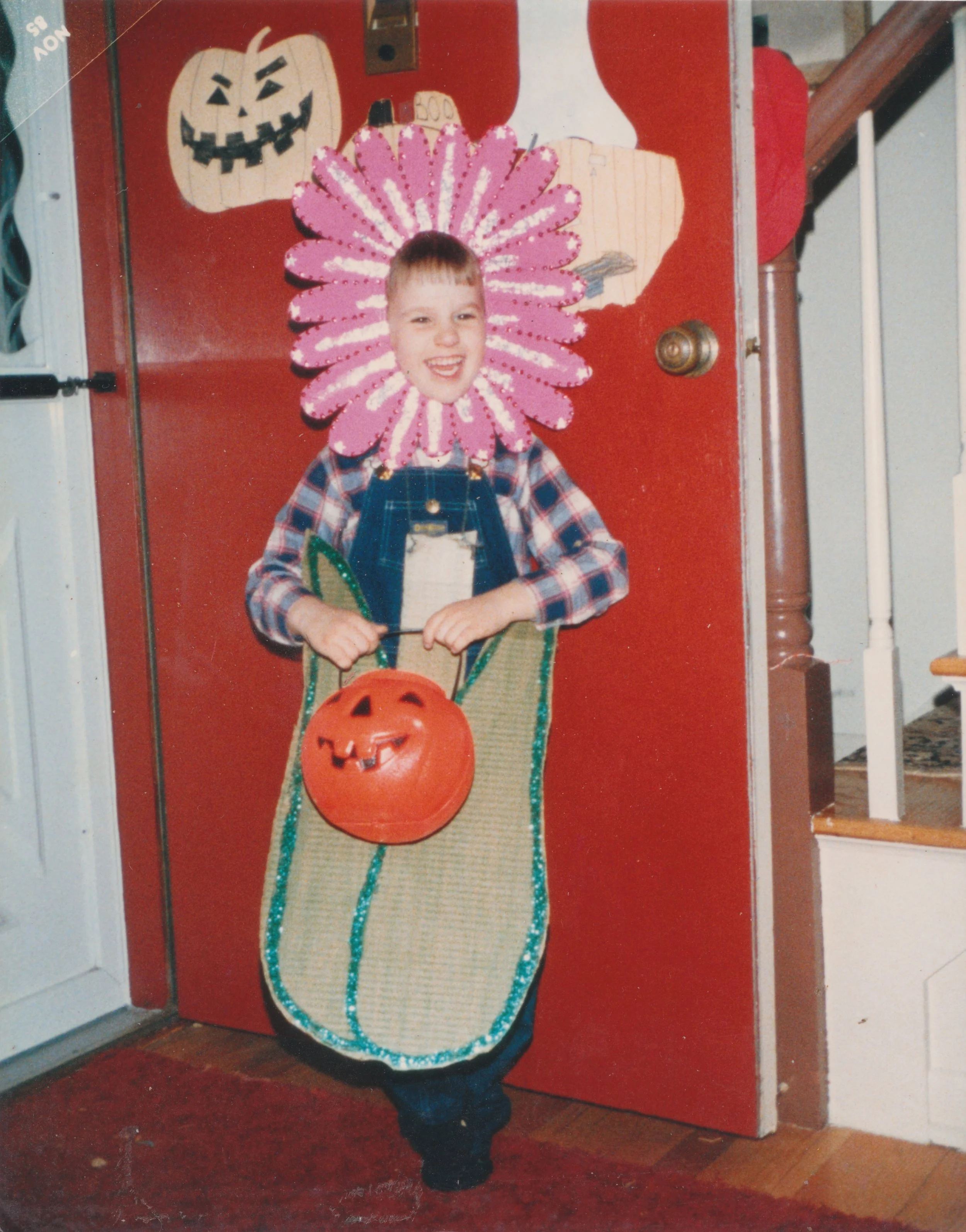
When I was five years old, I insisted on being a flower for Halloween, which to this day remains one of the queerest-coded demands I have ever made. My parents, to their great credit, made it happen, and photos from that year show me beaming from behind cardboard petals, clutching an orange pail of candy. The candy was great, but I’m still chasing the high of being a flower for a night.
That, of course, is part of the appeal of Halloween — it’s a time to put on a new identity, to be something new — often a thing that, for the rest of the year, might raise some eyebrows. And no wonder that act of shape-shifting is especially important to queer people! You’ve probably heard Halloween referred to as “Gay Christmas,” and the pageantry and masquerade is certainly a big part of that. (As Titus says on Kimmy Schmidt, “it’s smoke and mirrors. Two things gay men love!”)
But there’s more to it than that, I believe. Given our status as outsiders, it’s also no surprise that queer people have long identified with monsters, and have been foundational creators of horror fiction for as long as the genre has existed. I think the best example of our presence is in vampire tales: Jump back to the 1800s, and you’ll find the sapphic longing in Carmilla, the youthful passion of Karl Ulrichs’ Manor, and whatever the hell was going on with Bram Stoker and his mesmeric obsession with erotic gay poetry. (In his novel, Dracula’s physical appearance is a sort of merging of Walt Whitman and the actor Henry Irving, in whose sway Stoker placed himself for much of his adult life.) Even creepy wormy Count Orlok from 1922’s Nosferatu is a product of queer loss, as director F. W. Murnau processed the death of his lover a few years earlier in World War I.
As a result, today we have a wealth of queer vampires to enjoy (at some point, I’m sure I’ll do a video about The Hunger and The Lost Boys). My favorites are the sensitive sadboy vampires of Anne Rice’s Vampire Chronicles, a multi-novel series that is now a luscious AMC show. Previous adaptations of Interview with the Vampire and The Vampire Lestat were timid about admitting just how eager these vampires were to jump into bed together, but for this new series those inhibitions have been shed as eagerly as their clothing.
Louis and Lestat aren’t only my favorites because they’re so sexy (although that doesn’t hurt), but also because in a genre that is already very queer, they are among the queerest. I just posted a new video about the surprising similarities between these chompy vampires and real-life queer historical figures — and why the show provoked unexpected feelings of anger as I watched it. Check out that video here.
I don’t know what it says about my psyche that I wanted to be a flower as a child, and now I find myself drawn to these ravenous creatures of the night. But part of the magic of gay Christmas is that with the possible exception of Elvira, nobody’s locked into one costume for life, and we’re all free to try on as many outfits as we like. Flower today, vampire tomorrow.
